
Every summer three clubs arrive from the Championship, and every year the same question follows: can they stay up? For a while the answer seemed to be getting worse. In 2023-24 and again in 2024-25, all three promoted clubs went straight back down. Then 2025-26 broke the pattern, with two of the three surviving and one finishing seventh. Here is what the data says about the jump between the divisions.
The seasons when everyone went down
| Season | Promoted clubs | Outcome |
|---|---|---|
| 1997-98 | Bolton Wanderers, Barnsley, Crystal Palace | All three relegated |
| 2023-24 | Burnley, Sheffield United, Luton Town | All three relegated |
| 2024-25 | Leicester City, Ipswich Town, Southampton | All three relegated |
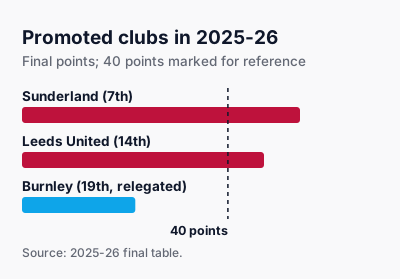
| 2025-26 | Sunderland, Leeds United, Burnley | Sunderland 7th, Leeds 14th, Burnley relegated |
Before 2023-24, the last time all three promoted clubs had gone straight down was 1997-98, and that had never happened before then. Two wipe-outs in a row were therefore without precedent.
In April 2025, Opta Analyst calculated that Leicester, Southampton and Ipswich were averaging just 0.51 points per game together, on course for the lowest combined total of any relegated trio in top-flight history.
Why the gap grew
Several explanations are commonly given, and they reinforce each other:
- Money. Premier League clubs receive far more from broadcasting than Championship clubs, which lets established teams build deeper, more expensive squads.
- Squad depth. Promoted clubs often arrive with players who were excellent in the Championship but have little top-flight experience.
- Spending rules. Profit and sustainability rules limit how quickly a promoted club can spend its new income.
- Bounce-back clubs. Some recently relegated clubs return with stronger squads than other promoted teams, while others come up after a single strong season.
Key point: The gap is not only about quality. A promoted club that faces better opponents every week spends more time defending, which makes it harder to show what it did well in the Championship.
What tends to predict survival
Looking at the clubs that stayed up, a few patterns appear:
- A solid defence. Promoted teams rarely outscore established sides; the survivors usually concede few enough to collect draws.
- Early points. A good start builds confidence and gives a buffer for the hard months.
- Points against direct rivals. Matches against other teams near the bottom are worth more than they look, because they take points away from a competitor.
- Underlying numbers. Expected goals for and against are a better guide to the second half of a season than the table in October.
2025-26: a sign of change?
Sunderland's seventh place with 54 points, the best promoted total since Leeds in 2020-21, and Leeds' 14th place show that the wipe-outs of the previous two seasons were not inevitable. One season is not a trend, though. The economic gap between the divisions has not disappeared, and the next set of promoted clubs will face the same hurdles. The full 2025-26 table is in The 2025-26 Premier League Season in Numbers.
Watch out: Small samples mislead in both directions. Three relegated clubs in a row, or two survivors in one season, say less about the system than the long-term record does.
For the metrics that help judge whether a promoted side is genuinely good or just lucky, read How to Read Football Stats: xG, xA and PPDA.
- All three promoted clubs were relegated in 2023-24 and 2024-25, which had only happened once before, in 1997-98.
- In 2025-26, Sunderland (7th) and Leeds (14th) survived; Burnley went down.
- Defence, early points and results against direct rivals are common traits of survivors.
Sources
- The Premier League-Championship chasm is widening — Opta Analyst, April 2025
- 2025–26 Premier League — Wikipedia: final table and promoted clubs

Premier League and Champions League by the numbers.