
For clubs in the Champions League, a normal week often means two matches: the league at the weekend and Europe in midweek. Managers complain about the schedule, rotate their squads and worry about injuries. Do the data back them up? A well-known study gives a nuanced answer: physical performance holds up surprisingly well, but injuries do not.
The study
In 2010, a team led by Grégory Dupont published a study in the American Journal of Sports Medicine. They followed 32 professional players of a top-level club playing in the UEFA Champions League over two seasons, 2007-08 and 2008-09. They compared weeks with one match and weeks with two.
They measured physical performance in 52 home matches (total distance, high-intensity running, sprint distance and number of sprints) and recorded every injury.
What they found
Physical performance was not significantly affected. Players covered similar distances and made a similar number of sprints whether they were playing once or twice a week.
The injury rate was much higher. With two matches a week, the rate was 25.6 injuries per 1,000 hours of exposure, against 4.1 with one match a week.
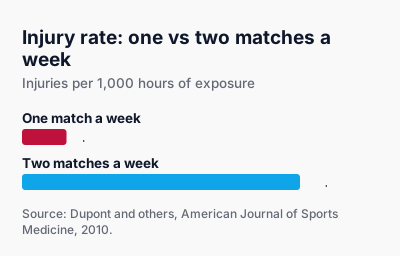
The authors' conclusion: 72 to 96 hours between matches seemed enough to maintain the physical performance they tested, but not enough to keep the injury rate low.
Key point: Running numbers can look normal while the risk is building up underneath. A player may cover the same distance on Saturday as on Tuesday and still be much more likely to get injured.
Why this matters for results
The study measured physical output and injuries, not results. But the link to results is easy to see:
- Injuries remove players. A congested month can cost a team several key players at once.
- Rotation changes the team. Managers who rotate to protect players may field weaker line-ups in some matches.
- Recovery and training time shrink. With two matches a week, there is little time to work on tactics.
How clubs respond
- Squad rotation. The study's authors specifically pointed to rotation as a way to keep injury rates down.
- Recovery strategies, from nutrition and sleep to physiotherapy between matches.
- Load monitoring, using GPS data to see which players are most at risk.
Example: Invented schedule for illustration. A club plays on Saturday, Tuesday, Saturday and Wednesday. A manager who starts the same eleven in all four matches asks each player for 360 minutes in 11 days. Rotating two or three players per match keeps the team's level similar while giving most players a full week of rest at some point.
What to look for as a fan or analyst
- Count the days between matches, not just the number of matches.
- Check who is rested. A team's league result after a Champions League night often depends on rotation.
- Watch injury lists in congested months, especially for clubs with thin squads.
Watch out: Congestion is one factor among many. A strong squad with good depth may cope easily, while a smaller squad can suffer even with fewer matches. Do not explain every bad result with tiredness.
For the format that creates this schedule, read Champions League Format Explained With Data, and use the xG match calculator to check whether a tired team really played worse or was simply unlucky.
- In a two-season study, physical performance did not drop with two matches a week.
- The injury rate was about six times higher: 25.6 against 4.1 per 1,000 hours of exposure.
- Rotation and recovery matter most during congested periods.
Sources
- Effect of 2 soccer matches in a week on physical performance and injury rate — Dupont and others, American Journal of Sports Medicine, 2010
- Effects of game weekly frequency on subjective training load, wellness, and injury rate in male elite soccer players — PubMed Central

Premier League and Champions League by the numbers.