
Jump to a topic
A perfect pass can end with a shot over the bar and no assist. A routine pass can become an assist if a teammate scores from a difficult angle. Expected assists (xA) help separate the quality of the chance created from what the next player does with it.
What xA measures
Expected assists assign a probability to a pass that leads to a shot. That estimate is based on the chance created by the pass: factors can include where it starts and ends, its type, distance, and the pattern of play. The exact inputs and definitions vary between data providers.
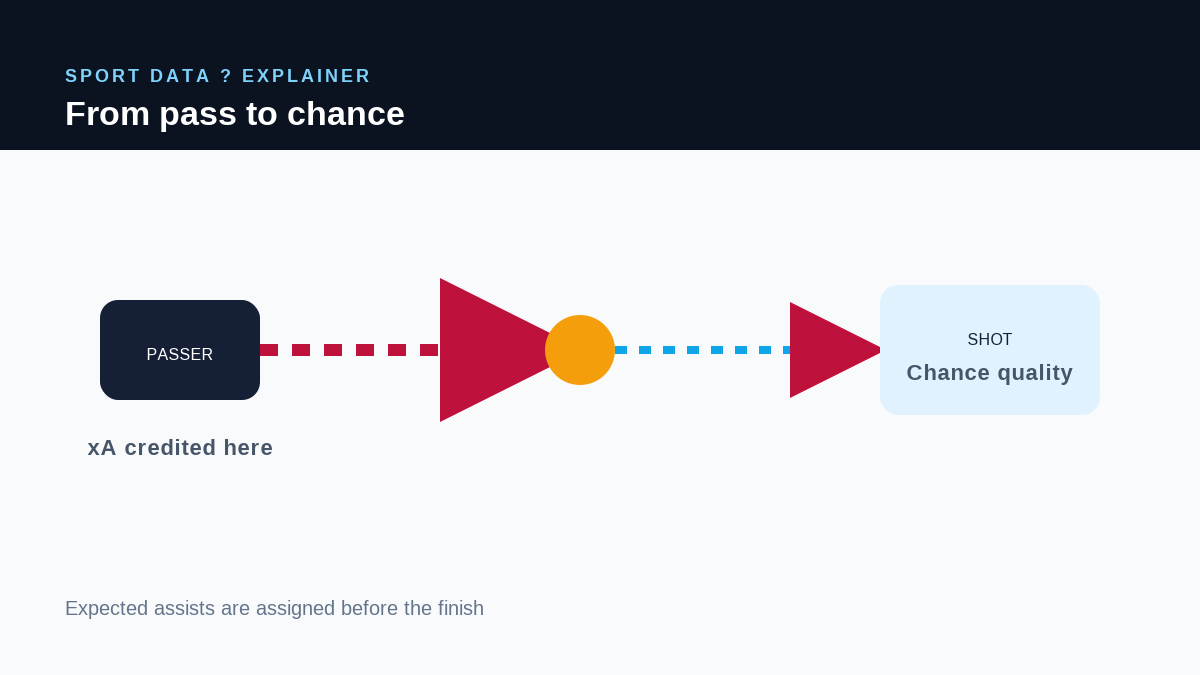
In a common provider definition, the passer receives xA credit when a completed pass leads to a shot, whether or not the shot becomes a goal. A cut-back followed by a miss can therefore still add to the passer's xA. A pass that is not followed by a shot generally does not.
xA and assists are not the same
An assist records the final action before a goal. xA estimates the quality of the opportunity created before the outcome is known. Over a small number of matches, those numbers can diverge:
- A player with more assists than xA has benefited from finishing above the model's expectation, at least in that sample.
- A player with more xA than assists may have created good chances that teammates did not convert.
- Neither gap proves that a player is lucky or unlucky; it is a prompt to look at the underlying passes and sample size.
Example: Illustrative only. Suppose a player creates three shots with xA values of 0.10, 0.20 and 0.30. Their total is 0.60 xA. That does not mean the player should receive exactly 0.60 assists in the match; it is the sum of estimated probabilities for the chances they created.
The same logic explains why xA is useful across several matches. If the players receiving the passes miss, the creator can still have a strong xA total. If a teammate scores from a low-probability chance, the assist appears in the record even though the pass did not create a particularly good opportunity.
How to compare creators
For a fair comparison, check the competition, data provider, minutes played and role. Total xA rewards players who play more; xA per 90 minutes adjusts for time on the pitch, but can exaggerate a short substitute appearance. Read the rate together with the total and the number of minutes.
Also look at the types of chances. A player who regularly creates high-value chances may be more influential than one whose passes lead to many low-probability shots. xA says little about passes that do not produce a shot, ball progression, defensive work or the tactical difficulty of a pass.
Limits of xA
- Definitions differ. Some sites estimate the probability of an assist; others use the xG of shots that followed a player's passes. Do not compare figures until the definitions match.
- It depends on the model. Providers use different event data and assumptions, so their totals may not agree.
- It is not a complete creativity score. A pass that breaks a line but is not followed by a shot may receive no xA.
- Small samples are noisy. A handful of chances is not enough to establish a player's usual level.
Check the definition used by the data provider before comparing players from different competitions or websites. Even when two sites use the same label, the inputs and treatment of rebounds, deflections or blocked shots may differ.
Put xA in context
Use xA alongside assists, minutes, role and video. For attackers, expected goals (xG) can show what happened after the pass; for midfielders, progressive passes or carries can reveal useful actions that never led directly to a shot. No single metric captures every way a player creates an advantage.
For a broader explanation, read our guide to xG, xA and PPDA, or compare chance quality with the xG match calculator.
- xA estimates the opportunity created by a pass, not whether the shot goes in.
- Compare players using the same provider and consider minutes, role and sample size.
- Use xA alongside assists and video, not as a standalone ranking.
Keep the provider's definition visible
Check whether xA refers to shot-linked expected goals or a model assigning value to the pass itself. Compare players using the same definition, minutes and role. A creator's actual assists also depend on finishing, so read the gap without treating either measure as a complete judgement.

Premier League and Champions League by the numbers.